Page Content
Project Overseas 2011: Canadian teachers and Ghanaidan colleagues (the Canadian and Ghanaian team called themselves Ghanadian)
In 1962, Saskatchewan teacher Penny Banks and Ontario teacher Clarke Macdonald visited Nigeria to help that country’s teachers upgrade their teaching qualifications, and Project Overseas (PO) was born.
Since then, almost 2,000 Canadian teachers have participated in PO and provided service to teachers in 59 countries, and over 100,000 members of overseas national teacher organizations have benefitted from PO.
The Canadian Teachers’ Federation’s (CTF) PO program is praised by teachers around the world for introducing practical, hands-on learning activities and a child-centred methodology that have transformed many classrooms. Overseas teacher organizations understand that systematic professional development (PD) services lead to increased active membership.
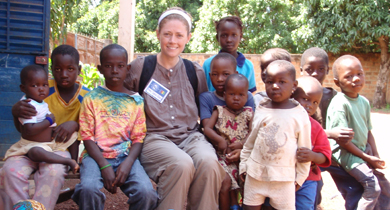 2009 Project Overseas participant Sara Alarie and local children in Guinea
The Alberta Teachers’ Association’s (ATA) longstanding commitment to international development education, development cooperation, sustainable development and PD dates back to 1964, when the first group of Alberta teachers joined their colleagues in Nigeria. Since then, more than 420 Alberta teachers have participated in PO in over 50 countries in Asia, Africa and the Caribbean, and over $3,600,000 has been donated to PO and other worthy ATA-sponsored projects.
Project Overseas evolved to respond to needs in Africa, Asia, the Caribbean and Central America. Active members now have access to ongoing PD through government or teacher organization training financed within the country. Still, many teachers in the marginalized and remote areas of Africa are languishing due to inadequate preservice education programs and few or no upgrading opportunities, with the exception of those provided by PO teacher organizations. The ongoing changes to subject matter and continuous education reforms in many countries lead to inconsistent educational standards. Furthermore, many teachers have been neglected by all but their teacher organizations.
In the 1980s, CTF introduced programming on women’s issues and leadership though the addition of gender-equality workshops offered in collaboration with experienced teachers and local experts. The result was increased active participation by women teachers with PO teams that model non-sexist approaches and promote leadership roles for women.
As the awareness of the effect of HIV/AIDS on education increased, CTF added a component to the program to assist teachers who work with colleagues and students who are affected by AIDS. Project Overseas created important links between teacher organizations and local health workers to promote prevention, testing and an ethic of care.
In Mongolia, for example, CTF completed an English-language training program for teachers, and Canadian teachers have been instrumental in training Mongolian educators to increase their English-language teaching skills, including teacher training, establishing a resource centre and assisting with writing, reviewing and publishing English textbooks. This has had a positive influence on education in Mongolia, as English has become a successor to Russian as the language of business and second language learning in schools. Several Mongolian PO graduates have won national awards for their contributions to PD education in Mongolia.
Advances in technology, computer training and technology in teacher organizations have all affected PO programs. For example, inservice training has attempted to bridge the digital divide between urban and rural areas, and has drawn renewed attention to basic literacy and numeracy.
In addition to information and communications technology, new disciplines are now included in project initiatives. The Caribbean is a good example of where Canadian teachers have been a strong catalyst for introducing guidance counselling. Canadians have been praised for sharing their experiences with nonviolent discipline, classroom management, administration, inclusion, differentiation and multigrade teaching. In 2011, CTF piloted a Special Education Institute within PO that attracted interest from across the Caribbean. Special education, together with related topics of differentiated teaching strategies, approaches to literacy and inclusionary practices, has become the centrepiece of the work in the Caribbean.
The ATA has always been a strong supporter of PO and has published its experiences, stories and achievements in various ATA publications. A Vector Research study commissioned by CTF in 2004/05 found that the PO experiences of Canadian teachers have a positive effect on general teaching skills, the introduction of a global perspective in classrooms and the promotion of international and cross-cultural awareness in school communities. Many PO alumni have maintained contact with their overseas cotutors and continue to mentor, validate and learn from their teacher friends abroad. This summer, the ATA will send 10 Alberta teachers to work with partners in Togo, Jamaica, Ghana, Liberia, Uganda, Dominica and Grenada.
Although this 50th anniversary year marks the first year without financial support from the Canadian government, PO has always been, and remains, a program of CTF members and its overseas partners. Sponsorship of Canadian teachers has been a mainstay of the program, and additional funds have allowed our overseas partners’ programs to expand. The CTF international program is committed to a focus on PD and building overseas teachers’ skills.
Together we’ll continue to advance access to good quality education in the marginalized and remote areas of the world, with the goal that all children and youth will experience the effect that a qualified teacher has on their lives to achieve their potential.